When plastic catches fire, one of the most dangerous things that can happen is that it melts and drips, spreading flames to surfaces and materials below. Anti-dripping agents are added to plastics specifically to prevent this issue. They are a small but important part of making plastic products safer.
What Is an Anti-Dripping Agent?
An anti-dripping agent (ADA) is an additive mixed into plastic materials to stop or reduce the formation of burning drips when the plastic is exposed to fire or heat. It works by holding the molten plastic together, so it does not drip or, if it does drip, the drips are less likely to stay ignited.
The most common type of anti-dripping agent is based on polytetrafluoroethylene (PTFE), the same material used in non-stick cookware coatings. In practice, PTFE is often used in an encapsulated or coated form to make it easier to mix into plastic compounds.
How Anti-Dripping Agents Work
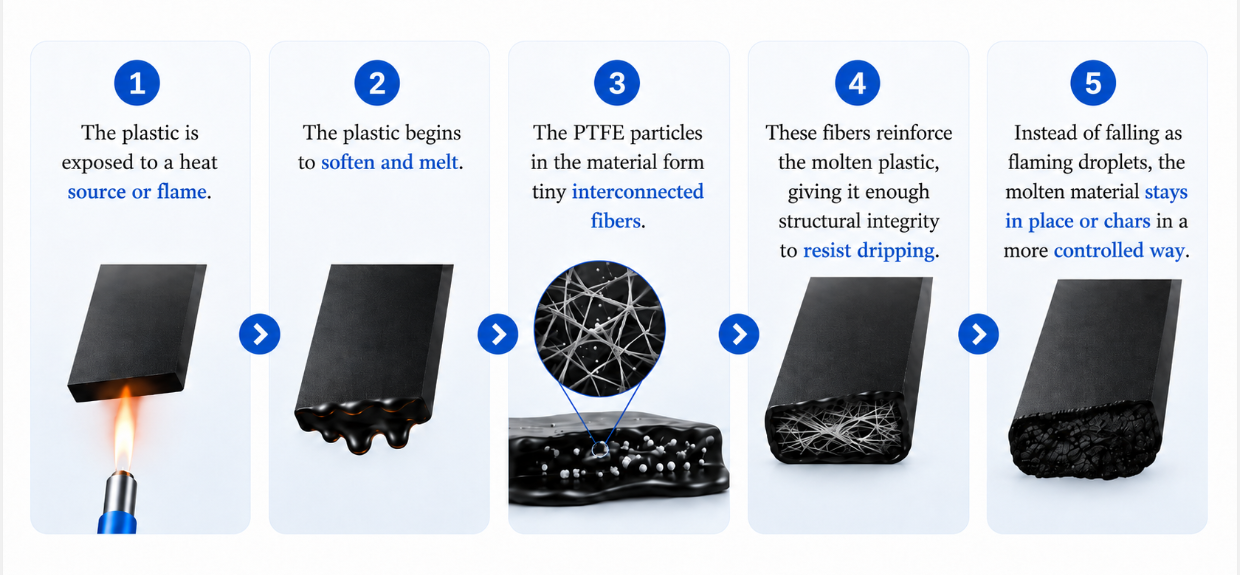
When a plastic containing an anti-dripping agent is exposed to heat, the PTFE particles within the material start to form a fine network of fibers. This fibrous structure acts somewhat like a mesh, holding the melting plastic together and preventing it from flowing and dripping freely. This effect is often described as “fibrillation.”
Why Are Anti-Dripping Agents Used?
The main reason manufacturers add anti-dripping agents to plastics is to meet fire safety standards, particularly the UL 94 standard.
Developed by Underwriters Laboratories, the UL 94 standard evaluates how plastics behave when exposed to an open flame, measuring ignition time, self-extinguishing performance, and whether flaming drips ignite a secondary cotton indicator.
With anti-dripping agents added to the formulation, thermoplastics such as polycarbonate (PC), acrylonitrile butadiene styrene (ABS), and PC/ABS blends can achieve UL 94 V-0 or V-1 ratings, which are common standards for plastics used in:
- Electrical and electronic equipmentincluding computer housings, power adapters, circuit breaker enclosures, and consumer electronics
- Automotive components
- Home appliances,such as washing machines, air conditioners, and other household devices where plastic enclosures must meet safety certifications
- Office equipmentincluding printers, copiers, and data storage enclosures
Typical Concentration of Anti-Dripping Agent
One notable characteristic of anti-dripping agents is that very little is needed to be effective. They are often added at concentrations below 1% by weight of the total plastic formulation.
The exact concentration required typically depends on the type of plastic resin being used and the fire safety rating that needs to be achieved.
For reference, the following are the recommended use levels for Shine Polymer’s SN3300 anti-dripping agent across common plastic resins:
Plastic Resin | Recommended Concentration |
PC (Polycarbonate) | 0.50% |
ABS | 0.20% |
PC/ABS blend | 0.30% |
HIPS (High Impact Polystyrene) | 0.20% |
PBT (Polybutylene Terephthalate) | 0.30% |
*Note that the actual amount used in a given formulation should be adjusted based on testing results.
Frequently Asked Questions
1. Is an anti-dripping agent a type of flame retardant?
This is a common point of confusion, but the two are different.
A flame retardant is an additive designed to slow down or prevent the burning of a material. It works by interfering with the chemical or physical processes involved in combustion, for example, by releasing gases that dilute the flame or by forming a char layer on the surface.
An anti-dripping agent does not inherently stop a plastic from burning. It addresses dripping, a specific aspect of fire behavior. If a plastic with an anti-dripping agent catches fire, it may still burn but may not drip burning material onto other surfaces.
In practice, the two types of additives are often used together to achieve a high UL 94 rating.
2. Will adding more anti-dripping agent prevent dripping more effectively?
Not necessarily. Anti-dripping agents are effective within a specific concentration range. Using more than the recommended amount does not always translate into better fire performance. In some cases, it may affect the physical properties of the finished plastic part, such as surface finish, impact resistance, or color consistency. It may also cause processing issues during compounding or molding.
Conclusion
In short, anti-dripping agents play a straightforward but important role in plastic fire safety. They form a reinforcing fiber network within melting plastic and thus prevent flaming drips that would otherwise spread fire to surrounding surfaces. This makes it possible for polymers to meet the stringent requirements of fire safety standards such as UL 94 V-0.
At Shine Polymer, we offer PTFE-based anti-dripping agents for PC, ABS, PC/ABS, HIPS, PBT, and other thermoplastics. Contact Shine Polymer to discuss your resin type, target fire rating, and formulation requirements, and find a suitable additive solution for your application.